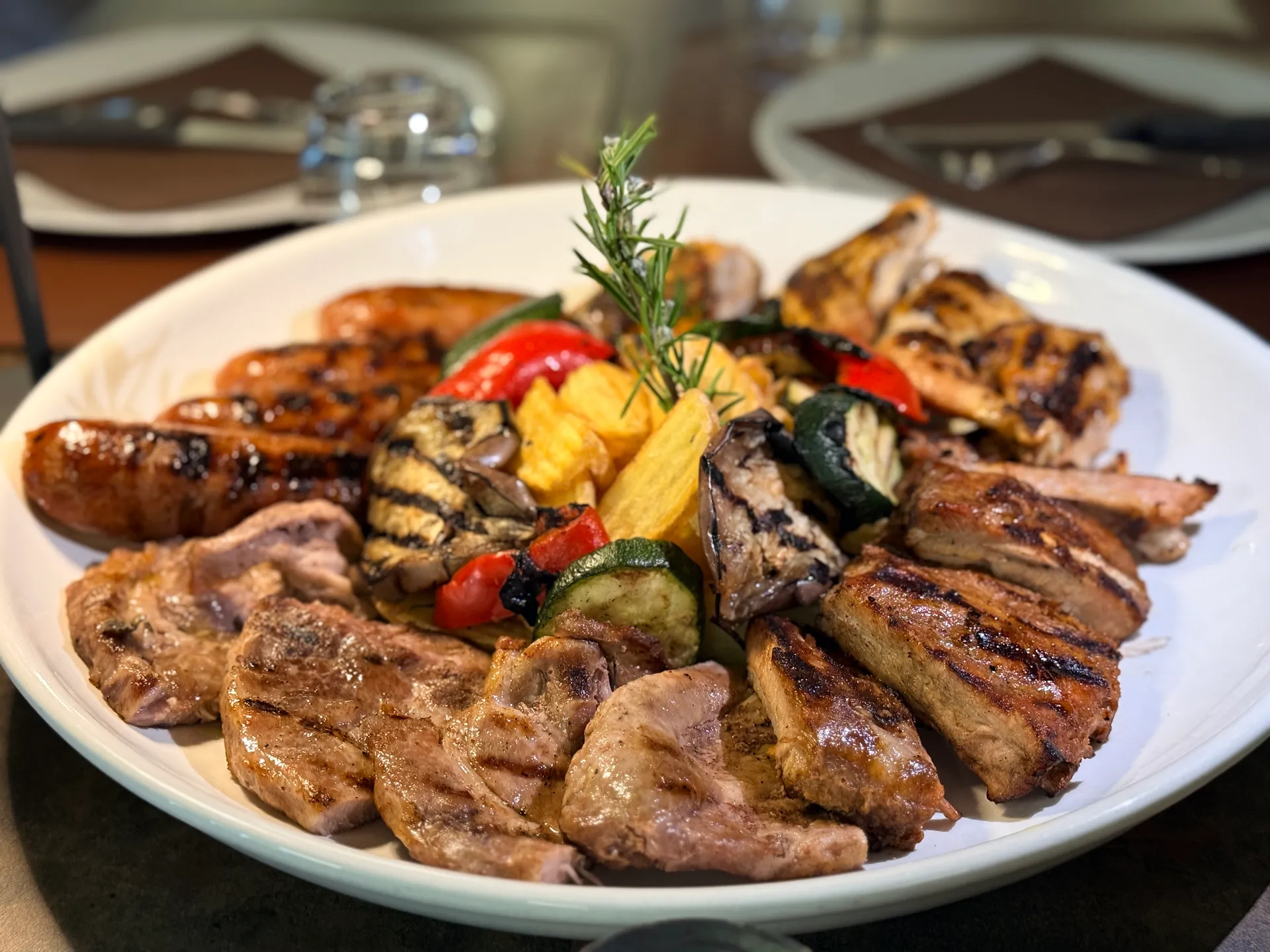
Tuscan menus often carry a word that means nothing to anyone outside the region: scamerita. You find it next to the sausages and the pork ribs, and almost always over the embers. Here it is on the grill every evening, in the mixed grill, and it is Cinta Senese scamerita. Here is what it is, why the breed makes the difference and how we cook it.
What scamerita is: which cut of pork
Scamerita is the Tuscan name for fresh pork collar (capocollo): the cut between the neck and the loin, along the top of the back. It is marbled with fat, and it is that fat, melting over the embers, that keeps it tender and juicy while the outside takes on colour.
The name changes with what you do to it. Fresh, for cooking, it is scamerita. Salted and cured it becomes capocollo, or coppa, sliced thin as a cured meat. The same cut with two fates: one ends up on the charcuterie board, the other on the grill.
Cinta Senese scamerita: why the breed matters
Our scamerita comes from Cinta Senese, the Tuscan pig breed you recognise at a glance: a dark coat with a white band around the shoulders, the "cinta" (belt) that gives it its name. It is ancient: you can already see it in Ambrogio Lorenzetti's fresco of 1338-39 in the Palazzo Pubblico in Siena.
According to the Consorzio di Tutela della Cinta Senese DOP, it is a breed suited to free-range and semi-free-range farming: in the woods it feeds on grasses, roots, wild berries and acorns, and grows slowly, which contributes to the quality of the meat. With the industrialisation of farming after the war it nearly disappeared: by the 1980s only a handful of animals survived. Since 2012 it has been a DOP (protected designation of origin), and the certified supply chain is entirely Tuscan: birth, rearing and slaughter.
How we grill scamerita
There is no secret recipe here: scamerita goes over the embers, on the same grill where the rest of the evening's meat cooks, from the sausage to the Florentine steak. We serve it with bay leaf and a garlic pesto, two aromas that stand up to the richness of Cinta pork without covering it.
If you cook it at home
Three general grilling rules, true for any fatty cut:
- Embers, not flames. Dripping fat raises flames that burn the outside and leave the inside raw: well-lit embers are better than an open fire.
- Don't pierce it, and turn it rarely. The fat should stay in the meat, not end up on the charcoal.
- Not too thin. A thin slice dries out before it takes on colour.
Which wine to drink with scamerita
For scamerita our list has a wild card: the Rosato Rita from the Langhe (€ 18,00), with the freshness of a white and the body to stand up to pork. If you prefer red, our wine pairing guide walks through the Tuscan labels on the list.
Where to try it near Florence
Cinta Senese scamerita is part of the mixed grill in our All You Can Eat at €29.99 per person: grilled meats without limits, alongside Tuscan starters, side dishes and wood-fired bread. Cover charge, drinks and desserts are excluded and paid à la carte. We are at Viale XX Settembre 200 in Sesto Fiorentino, inside the Fantastic Garden villa, ten minutes from Florence. Have a look at the menu and book a table.