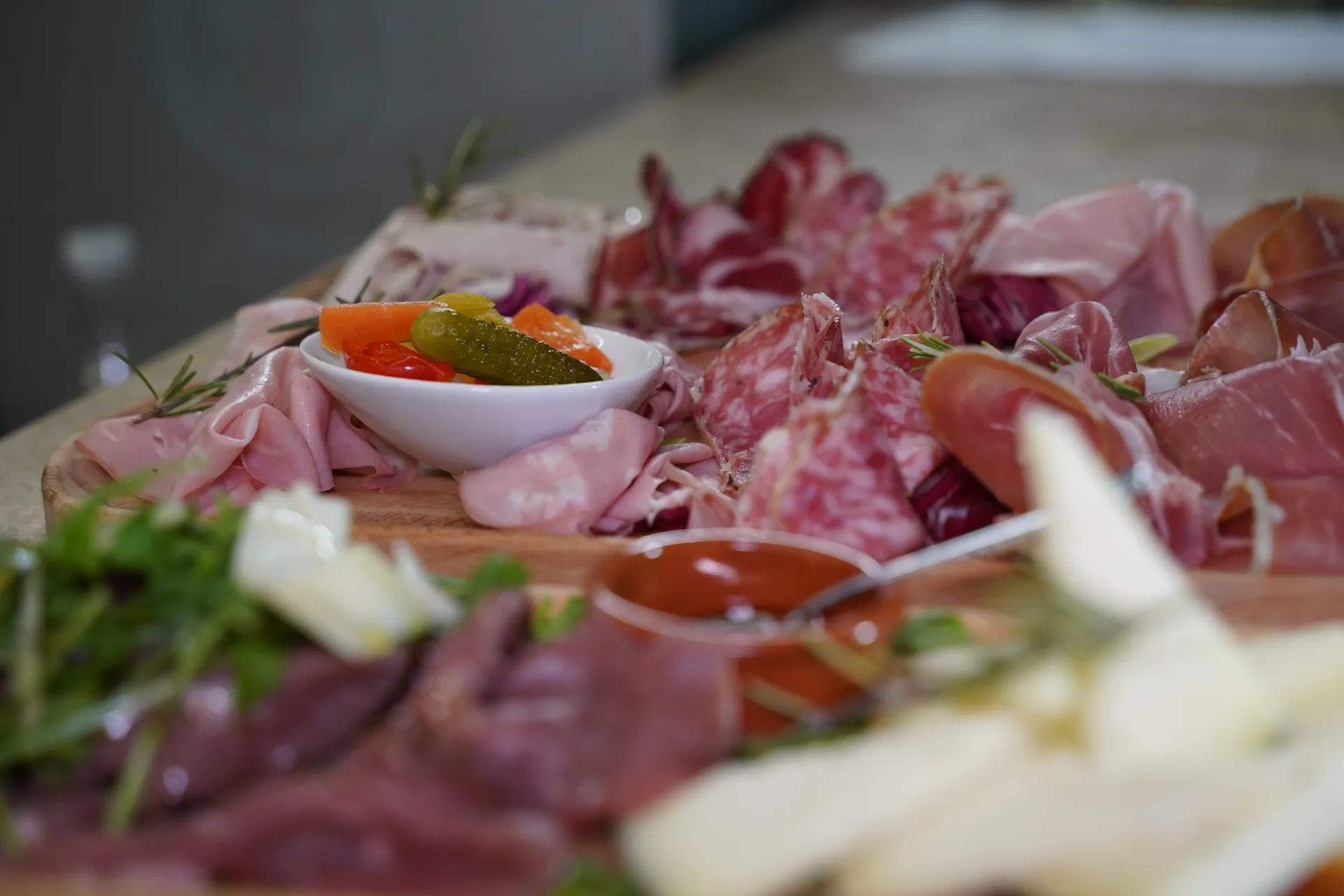
On a Florentine board, next to the prosciutto, there is almost always a basket of golden, puffed up balls: these are coccoli. Florentines grow up with them; visitors usually ask what they are. They are fried dough, one of the simplest things in Tuscan cooking, with a history that has been passed on by word of mouth more than in books.
What coccoli are
Coccoli are balls of leavened dough, fried: crisp outside, soft and slightly hollow inside. They are eaten hot, torn open with your fingers and filled with a slice of Tuscan prosciutto and, in the most classic version, stracchino, a soft fresh cheese. They are not a knife and fork dish: they sit in the middle of the table with the cured meats, before everything else.
A story of bread and leftovers
There is no document that dates the birth of coccoli. The most common account ties them to an old habit of Tuscan cooking: waste nothing, least of all bread. It is the same kitchen that turned stale bread into panzanella, ribollita and pappa al pomodoro. A piece of leftover bread dough, or pizza dough, went into hot oil and became something to eat straight away, hot, with whatever was in the house.
For a long time coccoli were street food, sold in friggitorie, the shops that fried food to eat on the go. The Michelin Guide notes that Florentines of a certain age remember childhood trips to the friggitoria with nostalgia, and that those shops have almost disappeared. Coccoli stayed: from the street they moved onto the antipasto board and into the aperitivo.
Why they are called coccoli
There is no final proof for the name either, and there are two theories. The first is the obvious one: coccole means cuddles in Italian, a fitting word for something warm, soft and comforting. The second looks at the shape: in Italian a coccola is also the small round berry of the juniper, and a fried coccolo has exactly that shape, round and puffed. In Florence, anyway, nobody doubts what will arrive when you order «i coccoli».
Coccoli, donzelle, ficattole: one fritter, many names
Fried dough belongs to the whole of Tuscany, but every area gives it its own name and shape. Besides the round coccoli there are ficattole and donzelle, also called zonzelle, longer or cut into diamonds, and in some places simply «pasta fritta». The name and the shape change; the idea, a simple dough in hot oil, stays the same.
A famous relative already appears in La scienza in cucina e l'arte di mangiar bene by Pellegrino Artusi, the cookbook published in 1891 and written in Florence. Recipe no. 191, the Donzelline, is a dough of flour, butter, milk and salt cut «into small almonds» and fried «in lard or in oil», which Artusi then dusts with icing sugar: a sweet version, without yeast. A little further on, at no. 194, the Crescente gives him a chance to tease the way people speak in Bologna: the first time he heard the word he thought they were talking about the moon, and it turned out to be «ordinary fried dough».
Outside Tuscany the family is large: gnocco fritto in Emilia, crescentina in Bologna, pettole in Puglia. Each with its own name, all with the same idea.
How we serve them
Our coccoli start from the traditional leavened dough, but instead of going into the oil they bake in the wood-fired oven, and come to the table hot together with the Gran Tagliere of Tuscan cured meats and cheeses that opens dinner. They are part of the All You Can Eat at €29.99 per person and, like the starters and the grilled meats, you can ask for more for as long as you are hungry. Cover charge, drinks and desserts are excluded and paid à la carte. For children there is the €15 kids menu, with coccoli and prosciutto, grilled frankfurters and burger, fries and a drink.
We are at Viale XX Settembre 200 in Sesto Fiorentino, inside the Fantastic Garden villa, every evening from 7:00 pm to 11:00 pm, with free parking. Have a look at the menu or book a table.